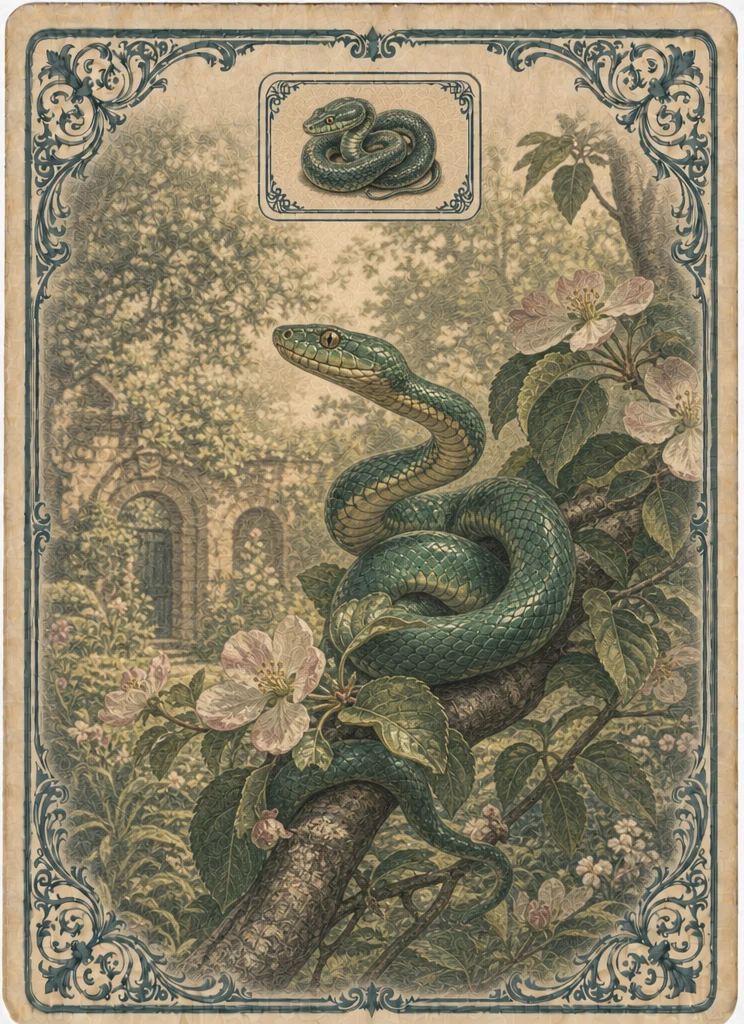
LENORMAND CARD ARCHIVE · 07 · Shadow
Snake
Also known as: The Serpent
Complication · desire · detour
Snake introduces complexity, indirect routes, temptation or competing interests. Depending on context, it may describe strategic behavior or a situation that requires careful navigation.
Content project: Lenormand Cards · Editorial method & sources
Back to card referenceQuick facts
- Playing-card link
- Queen of Clubs
- Yes / No
- No
- Timing
- Indirect and delayed; expect detours rather than a straight line
- Learning label
- Shadow
In love
In love, Snake can describe a complicated dynamic, competing needs, or indirect communication; it does not identify a rival by itself.
At work
At work, it may suggest a detour, overlapping interests, or a situation that calls for careful strategy.
Health theme
Tension, flexibility, and the need to avoid overextension
As advice
Stay observant about goals and incentives, and use direct, verifiable communication when the stakes are high.
Timing
Indirect and delayed; expect detours rather than a straight line
Symbolism
A winding path represents complexity, strategy, desire, and the choice of a safer route.
Combination example
Snake + Road is often expressed as Snake + Crossroads: a choice complicated by competing motives. Open related card: Crossroads
Turn a card meaning into a useful reading
- Choose one concrete keyword that fits your question.
- Read it with the adjacent card; describe how the second symbol changes the first.
- Write one sentence, then separate the symbolic suggestion from facts you can check.
Sources & reading notes
These are AI-assisted learning summaries, not a single authoritative Lenormand doctrine. Traditions vary; the question and neighboring cards change the interpretation.
A starting point for deeper study: The Complete Lenormand Oracle Handbook — Caitlín Matthews, Destiny Books, 2014. Publisher's book details
The publisher lists this book as covering card meanings, combinations, three- and five-card layouts, larger spreads, and historical context. This is a bibliographic recommendation; we do not claim that its author endorses this site or that every entry reproduces the book.
About, editorial method & sources →