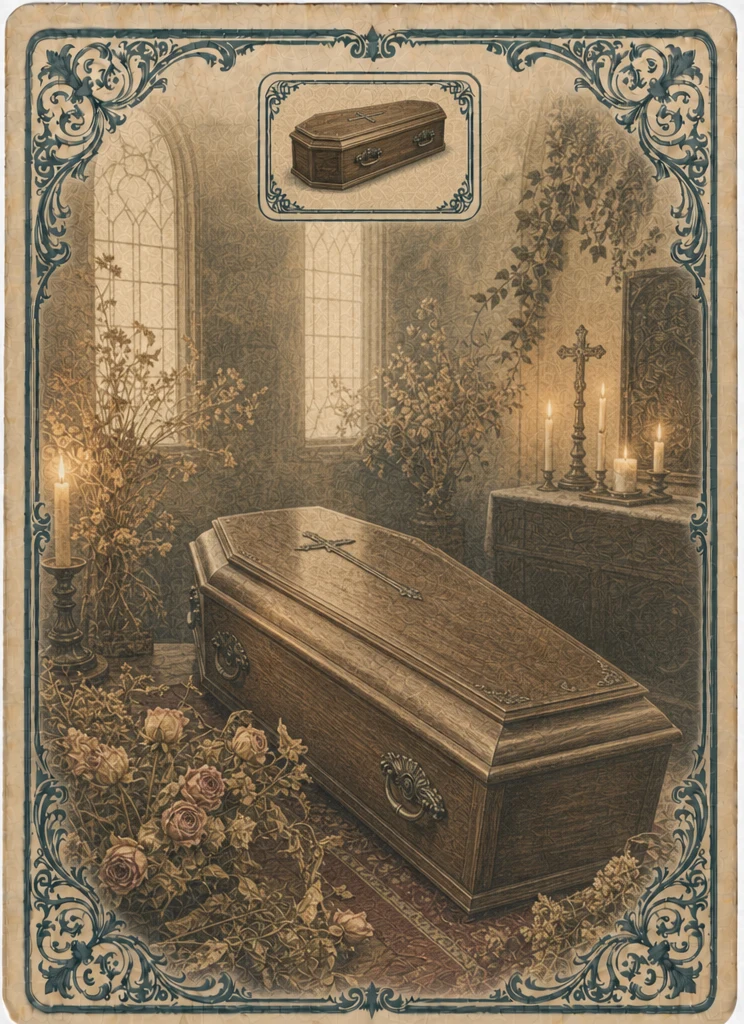
LENORMAND CARD ARCHIVE · 08 · Shadow
Coffin
Also known as: The Coffin
Ending · closure · stillness
Coffin marks a halt, the closing of a chapter or something that is no longer active. Its emphasis is cessation; any subsequent renewal depends on the rest of the reading.
Content project: Lenormand Cards · Editorial method & sources
Back to card referenceQuick facts
- Playing-card link
- 9 of Diamonds
- Yes / No
- No
- Timing
- Stopped or complete; the pause comes before a new phase
- Learning label
- Shadow
In love
In love, Coffin can describe a pause, an ending, or an old pattern that no longer has room to continue.
At work
At work, it may mark a project closing, an inactive role, or a work arrangement reaching its limit.
Health theme
Rest, closure, and recovery after an intense chapter
As advice
Acknowledge what has stopped, gather what you learned, and decide what can realistically begin next.
Timing
Stopped or complete; the pause comes before a new phase
Symbolism
A closed container marks an ending, stillness, and the space needed to release a pattern.
Combination example
Coffin + Letter can describe the end of correspondence or a written notice of closure. Open related card: Ring
Turn a card meaning into a useful reading
- Choose one concrete keyword that fits your question.
- Read it with the adjacent card; describe how the second symbol changes the first.
- Write one sentence, then separate the symbolic suggestion from facts you can check.
Sources & reading notes
These are AI-assisted learning summaries, not a single authoritative Lenormand doctrine. Traditions vary; the question and neighboring cards change the interpretation.
A starting point for deeper study: The Complete Lenormand Oracle Handbook — Caitlín Matthews, Destiny Books, 2014. Publisher's book details
The publisher lists this book as covering card meanings, combinations, three- and five-card layouts, larger spreads, and historical context. This is a bibliographic recommendation; we do not claim that its author endorses this site or that every entry reproduces the book.
About, editorial method & sources →