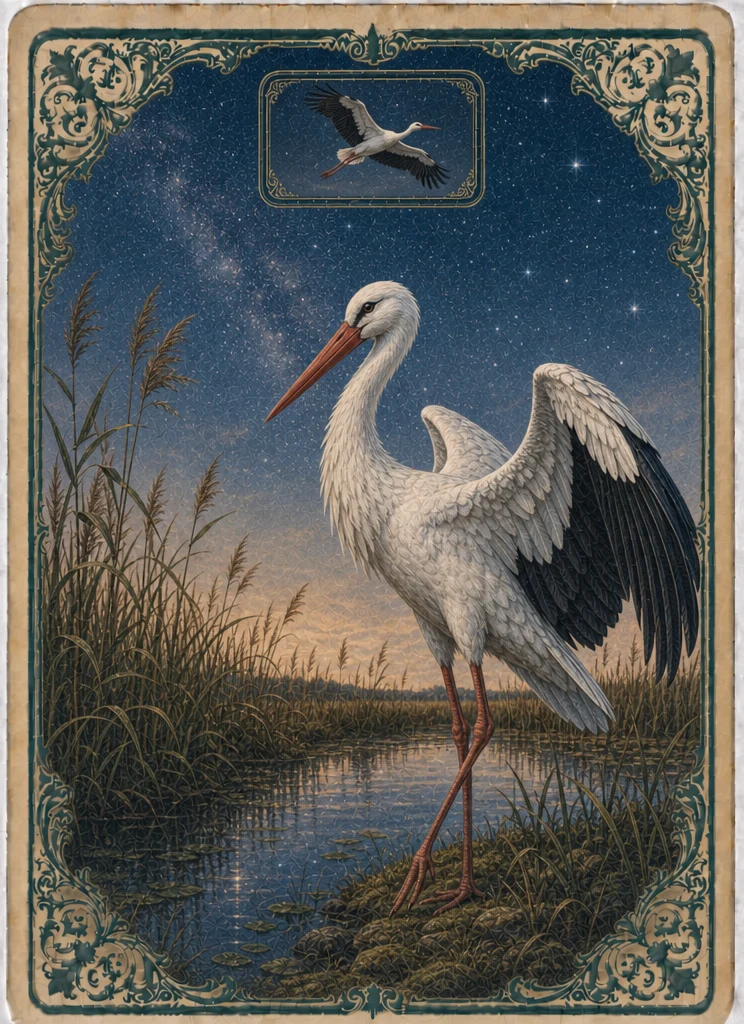
LENORMAND CARD ARCHIVE · 17 · Light
Stork
Also known as: The Stork
Change · transition · improvement
Stork brings movement between states: changing habits, relocating, upgrading or adapting to a new phase. Improvement is a common association, though neighboring cards qualify the experience.
Content project: Lenormand Cards · Editorial method & sources
Back to card referenceQuick facts
- Playing-card link
- Queen of Hearts
- Yes / No
- Caution
- Timing
- In transition; improvement comes through adjustment
- Learning label
- Light
In love
In love, Stork can mark a transition in routines or relationship status; nearby cards help describe the change.
At work
At work, it may point to an upgrade, a role change, relocation, or a process being improved.
Health theme
Movement, renewal, and adapting routines with care
As advice
Notice the changes already underway and test one practical adjustment before making a larger commitment.
Timing
In transition; improvement comes through adjustment
Symbolism
A migrating bird marks a change of place, habit, role, or life phase.
Combination example
Stork + House can suggest moving home or making changes within a household. Open related card: House
Turn a card meaning into a useful reading
- Choose one concrete keyword that fits your question.
- Read it with the adjacent card; describe how the second symbol changes the first.
- Write one sentence, then separate the symbolic suggestion from facts you can check.
Sources & reading notes
These are AI-assisted learning summaries, not a single authoritative Lenormand doctrine. Traditions vary; the question and neighboring cards change the interpretation.
A starting point for deeper study: The Complete Lenormand Oracle Handbook — Caitlín Matthews, Destiny Books, 2014. Publisher's book details
The publisher lists this book as covering card meanings, combinations, three- and five-card layouts, larger spreads, and historical context. This is a bibliographic recommendation; we do not claim that its author endorses this site or that every entry reproduces the book.
About, editorial method & sources →